TerraPass blog

Plug in and drive

Adam Stein | August 26, 2008

Shai Agassi says his electric cars can save the world. People are listening.


There’s a lot to chew over in Wired’s profile of Shai Agassi, the entrepreneur engaged in an audacious experiment to electrify an entire nation’s transportation system, and in the process rewrite the automotive industry’s business model.

The nation in question is Israel, with Denmark and Hawaii possibly to follow. Agassi’s idea is that electric cars should be sold on a subscription model, like cell phones, with fees used to underwrite a network of intelligent electric outlets that ensure batteries are always topped up.

The plan is quite a bit more complicated than that, but in essence Agassi is trying to solve the same problem that plug-in hybrids and the Chevy Volt are meant to address: batteries have a limited capacity and take a long time to charge up. Hybrids work around the problem by bolting a gasoline engine on top of the electric motor. Agassi’s start-up, Better Place, hopes to cut gasoline out of the picture altogether by remaking the electrical grid. It’s an audacious vision, and the company has the financing and the partnerships in place to upgrade their prospects from pipe dream to long shot. They hope bring their all-electric cars to market in 2011.

Like I said, there’s a lot to chew over here. A few thoughts come to mind:

  • Agassi doesn’t like plug-in hybrids, but his criticism seems overstated. In fact, plug-ins could fit nicely into Better Place’s model. Or, just as likely, plug-ins could co-exist as a competitive mode of transport. It’s even possible that the market will segment geographically. Better Place’s strategy of focusing on small, isolated locations — real or virtual islands — is both ingenious and self-limiting. Plug-ins might fill the gaps in the grid.
  • Agassi has hinted that his company would be willing to purchase green power to fuel its fleet. This is like placing a tax on transportation to fund the build-out of renewable energy. Which actually seems like pretty good public policy. (It’s also an interesting commentary that such a system might come out of the private sector, rather than the government.)
  • Although electrification of the transport sector is a clear benefit to the environment, the subscription model realigns incentives in ways that may alarm some greens. Remember all those conspiracy theories about how Detroit and the oil companies had teamed up to keep Americans driving huge, inefficient cars? Well, consider the implications of the pay-as-you-drive model for electric cars.

There’s a lot more to be said on this last point. It’s an article of faith among many that “car culture” itself is a problem, and that a green future will involve a lot more walking, public transportation, and bikes. While such a scenario may come to pass, it’s by no means a certainty (nor, it should be said, are such solutions incompatible with Better Place’s vision). The advent of the electric car could mean that the future looks a lot like it does now, only without any gas stations. It’s notable that under Better Place’s model, the cost of car ownership actually goes down, which means miles driven should go up. As alarming as this prospect may sound, it isn’t necessarily a problem. Personal mobility is a wonderful thing, a luxury for many and a necessity for most. If we can have mobility without the environmental cost, then so much the better.

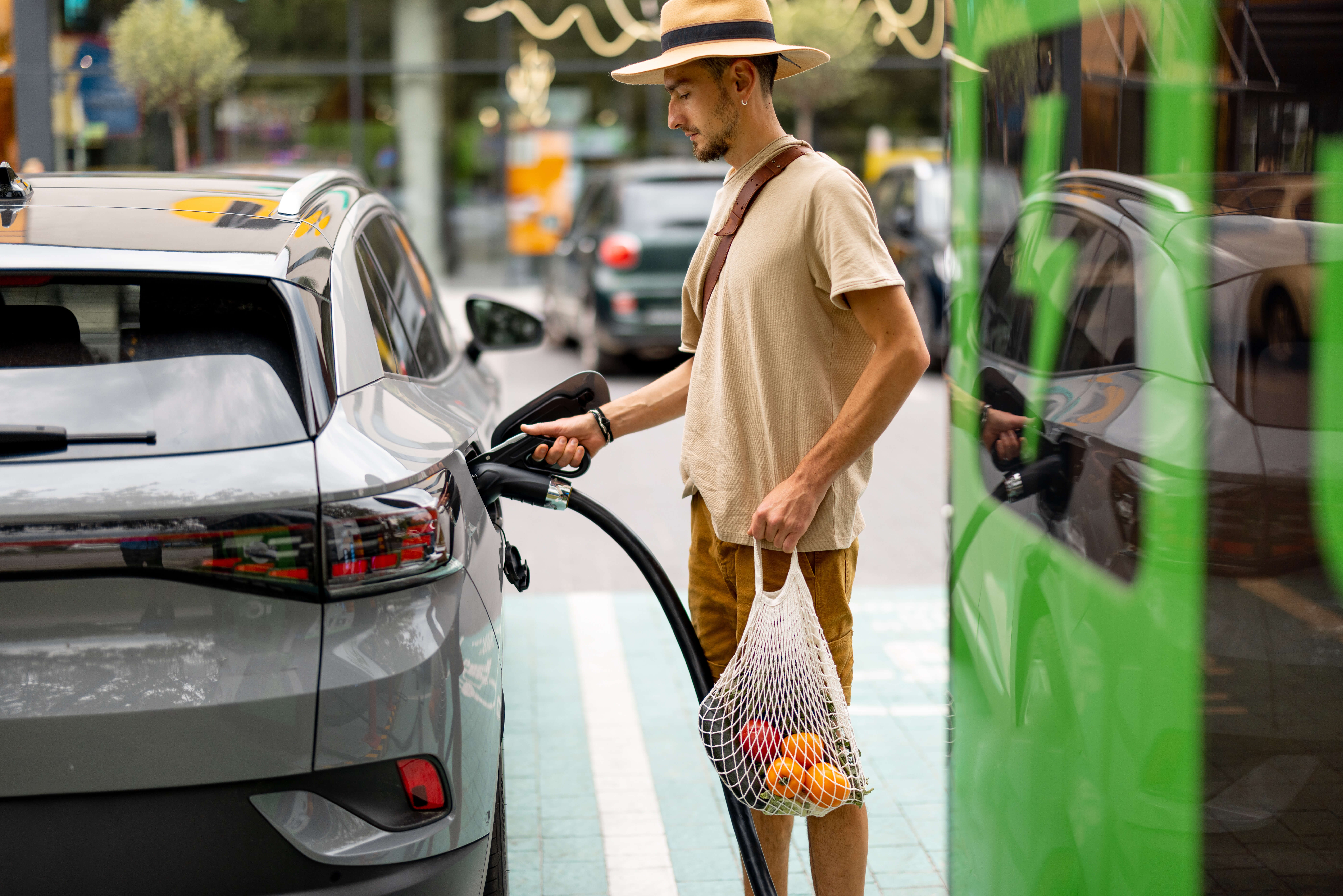
Image by Wired.

< Previous: Don’t judge a wine by its box    Next: Fill up your fridge >

Comments


  • 1.

    I love it when someone sees an entirely new facet of a problem. One of my favorite stories has the protaganist drive the axle out of a wheel when everyone else fails to pull the wheel from the axle.

    Having said that I now await the answer to the "car culture" problem because that is the problem.

    There is a way to have all the benefits of the "car culture" and none of the destructive drawbacks.

    Come forward, someone!


    Reply
  • 2.

    What about a system of underground or above ground wires (as in the old trolley/streetcar systems that finally folded in the '50's in cities in the U.S.? I remember them in Omaha.

    It might work very well on the interstate highway systems.


    Reply
  • 3.

    There are other companies that have similar concepts to Better Place that may be more practical, especially in large areas where there will be many different kinds of plug-in vehicles.

    My company, Coulomb Technologies, recently announced their ChargePoint Network, a subscriber based network of charging stations for Plug-in Hybrid Electric Vehicles (PHEVs), Extended Range Electric Vehicles (E-REVs), and Battery Electric Vehicles (BEVs). Coulomb is working with Auto OEMs to ensure that their stations are compatible with cars that are scheduled for delivery in the near future as well as existing Hybrid conversions, Neighborhood Electric Vehicles, and previous generation EVs.

    Charging stations are intended to be installed in public and private parking areas such as municipal parking lots, employee parking lots, airport parking lots, etc. Subscribers receive an RFID key fob that authenticates the user at any ChargePoint charging station. Subscriber revenue is used to pay for electricity and on-going maintenance of the charging stations. In addition the property owner where the charging stations are located gets a usage-based share of the recurring subscriber revenue as a monthly dividend check.

    Look for ChargePoint stations to start cropping up in San Jose, San Francisco, Santa Monica, Austin, Miami, New York, and Las Vegas starting in January of 2009.


    Reply
  • 4.

    Charging stations are fine, but having solar cells on the car that are dense enough to charge the battery sufficiently to get home after 8 hours at the office would be better.


    Reply
  • 5.

    Anything that moves us quickly towards an all-electric car future is good. Plug-in hybrids seem to me like a big and rapidly do-able step in that direction while better battery/capacitor storage for all-electric vehicles is being developed. I think most decentralised charging mechanisms are compatible with each other - whether commercially-operated charging stations powered by dirty coal (still less CO2 per mile than driving a Civic hybrid) or workplace solar carports. A key priority is to make sure investment is not diverted from electrically powered transportation into much less efficient biofuel systems.


    Reply
  • 6.

    Jay,
    Let's do some math on that. Figure a typical car has about 2 square meters of surface area that you could cover with solar cells. (A bigger car would have more area, but use more energy, so I think this washes out.) Assume you live in a sunny place like Phoenix, with an annual average daytime irradiance of about 500 W/m2. 8 hours of that at a PV efficiency of 20% would net you 0.8 kWh of stored power. That would take you 3 or 4 miles in a fairly efficient EV.


    Reply
  • 7.

    MH,
    It sounds like your ChargePoint Network could be the type of technology Better Place needs to deliver charging stations to their subscribers. Would a partnership be a possibility?


    Reply
  • 8.

    There are already in place 'service stations' -- what about standardizing batteries and their niche in the auto? As your battery goes down, drive into a station & exchange, for a fee, your depleted battery (or batteries) for one that's already charged. And/or install a small solar panel in the roof of the car for a trickle charge to help maintain lights, etc until you can get to the 'station'. Service stations can have a solar array on their roofs to provide electricity to the city grid so the batteries they have for exchange can be charged continuously without causing 'surges'in demand when the sun isn't out due to rain or night-time darkness.


    Reply
  • 9.

    Hi Virginia -- service stations where you can swap batteries are part of Better Place's plan. It's actually remarkably similar to what you describe.

    As for distributed solar, nothing wrong with it, of course, but you're not going to be able to make much juice this way. Ultimately utility-grade renewable energy will be the key.


    Reply
  • 10.

    Thank you Adam -- I've wondered what to call "distributed solar" --- my idea has to do with City Utility maintained and built solar arrays on every 'roof' in the city, and have the Utility pay a small fee to rent the space. Overall, I have an idea that using the roofs in an area will be cheaper than building from scratch somewhere out in a wilderness area to create a big "Solar Farm". Electricity produced locally this way and sent directly to the grid would eliminate the necessity of 'metering' how much each panel produces. Customers would continue to pay for electricity delivered to our households much as we do now. Not sure this has anything to do with electric cars, except for the availability of electricity. I think the biggest problem with out 'addiction to oil' is in truth an addiction to a lifestyle of convenience, to be able to hop in our cars to go buy a loaf of bread, for instance. Small all- electric cars would allow some of that ability to remain. Thank you, again. It's wonderful to see this work in progress.


    Reply
  • 11.

    ...according to the New York Times, many windmill farms are shutting off the power because they are overwhelming the grid...and ironically, if these farms do not shut down, they are charged by the electrical company(s).

    Perhaps these windmill farmers should sidestep the grid altogether and work directly with folks like Agassi...this is an entrepreneurial endeavor, yes?

    If our government doesn't posses the attachments or will to bring the grid up to first world status, we apparently have a network of folks who have some energy to sell...or will our government jump into its protectionist role...


    Reply
  • 12.

    RECHARGE CARS where they are PARKED. Nobody wants to waste time in this fast-paced culture hanging out at a charging station for the sole purpose of recharging their car.

    Next generation urban parking meters should ALL be wired with an electrical outlet an and option to pay for a recharge as well as the parking time. Easy to do, not rocket science.

    New corporate parking lots should be wired so employees can recharge their cars, and Federal tax incentives should make this worthwhile thing for companies to do.

    Electrical-wired parking lots are NOT NEW, and are already in place in some areas. It is done in various parking garages and lots in Alaska and Canada for a different reason: to plug in engine block heaters, which help keep oil warm in a cars engine while it is parked in frigid winter temperatures. This allows quicker starts, less engine wear, and reduced fuel consumption due to less warm-up engine idle time. I used to plug in my truck at the UAA dorm in Anchorage every night using a standard electrical outlet at my parking space. Just by making the outlets smarter, and using a unique hardware MAC address for the cars plug, this could be used on a wide scale with a subscription based system to allow .


    Reply
  • 13.

    But! the grid is a bottle neck akin to a poorly designed circuit in one's own house; drive electrical energy thru a too small line and things melt down...draw too much energy from the same line and we get brown outs and black outs. Our grid cannot handle new energy technolgy nor the potential demand of a new herd of electrical vehicles running at today's pace.

    The condition od our oil refineries and grid are reportedly are close to third world status...are we following a blind inept government or does our government have something up its technological sleeve? Turning its head is irresponsible...

    To be sure, I do not mean to limit these comments to our federal government...state and local governments create their own road blocks...


    Reply
  • 14.

    my personal utopia, if we must have a car culture at all: tweak the zipcar concept - very short term car rental with cars parked all over the city - only these cars would be little plug ins and they'd be identified by kiosk roofs covered in solar panels (maybe not enough for full charge but a good boost). Hunt down a yellow-edged awning with a green light on it, slide your membership card and off you go. :-)


    Reply
  • 15.

    Nice! And you may not know it, but your idea does away with the ego associated with car ownership...our ego can make some pretty bad choices if allowed to....


    Reply
  • 16.

    So I'll admit I didn't actually read the article, or any of the replies, but I figure this was the perfect opportunity to post my idea:

    Something I've been kicking around in my head for a couple years now is the idea of battery-pack swapping.
    Dino-fuel cars have a limited range, and must be refueled in order to extend that range.
    Electric cars have a limited range, and must be recharged to extend that range.
    But fueling a dino car takes 5 minutes, and charging an E-car takes 8 hours. Why not just swap the battery pack?
    Convert, or add to, dino-fuel stations into charging stations with racks of battery packs. When the pack on your E-car is running low, stop by a station and have the attendant swap the pack for a freshly-charged one.
    The time to swap a battery pack in an E-car will take about as long as fueling a dino-car; we would increase employment at the blue-collar level by the increased number of attendants needed (not an operation that the common driver should attempt, especially at 1000 pounds); we would not need to build virgin charging stations, since we could convert or add to existing dino-fuel stations; while every dino station is hooked into the electrical grid currently, there may be a need to increase capacity--but not necessarily--which would be minimal cost since electrical feeds already exist for each dino station; the charging system employed at the stations could be a heavy-duty industrial design (480V/60Hz/3P/600A power, or even more?), allowing entire battery packs to be charged in as little as 30 minutes (instead of the 8 hours at homes under 120V/60Hz/2P/125A power).
    Now if we really wanted to push for ultra-clean energy, we would incorporate solar and/or wind generation into every station conversion, perhaps even solar-concentrating technology.
    As far as I see it, aside from the lack of political or business will to take on this project, the only downside to this would be the dramatic increase in electrical demand placed on the grid and the generating stations. However, it would be smart to make this a double-impact project: at the same time a nation-wide effort was put into adding/converting these charging stations, we would pump massive funds into updating, repairing, renovating, and improving our electrical grid. This massive undertaking could be its own department or project under an Obama administration: think FDR's WPA or CCC or other New Deal organizations.
    And there's already a precedent for this battery-swapping idea: PPX (Pre-filled Propane eXchange). I'm someone who refills my barbeque propane tank when it's empty, but an awful lot of people simply bring in their empty cylinder to exchange it for a pre-filled one at their local grocery store or Home Despot.


    Reply
  • 17.

    You might want to read the article...


    Reply
  • 18.

    From Virginia F. Thank you Adam, for the suggestion 'to read the article', but since I have already read the article, & again since your post, I can't help but wonder if you have an idea in mind you think I'm missing. I have no idea what you could be inferring, so I'd prefer just ol' regular plain talk -- tell me! ;-)


    Reply
  • 19.

    Battery swapping is part of Better Place's plan.


    Reply
  • 20.

    From Virginia F.Thanks, Adam. There're all sorts of ideas about the possibility of swapping batteries, both in the article and in the comments, and I like the idea of charging batteries in the parking garage, or a boost from the meters at a parking spot in the city. Seems like one of the most urgent things in all of this is to create batteries that aren't so big & heavy, or to break them into 'modules' so you have the ability, because of the lighter weight, to charge a portion at a time.


    Reply
  • 21.

    From Virginia F. Is there a separate article "Better Place" and the article in "Wired" -- Maybe I'm missing some info?


    Reply
  • 22.

    Agassi's proposed battery cars miss a trick. The battery's are very heavy and need a lot of energy to transport them. MWVs (minimum weight vehicles) such as Microdot (see Wikipedia), today should have 4 hub electric motors, a tiny back-up petrol engine, and draw their power by linear induction from an under-the-surface cable laid along every road traffic lane; with power from clean generators. Induction power (non-contact) has been used for trams for decades. We will apply these principles for the mass transport of food and use only 10% of the energy used to propel heavy lorries. Noel Hodson - FOODTUBES.


    Reply

The comments section is now closed.


AddThis Feed Button
CATEGORIES

Conservation tips
News
Politics
Science & Technology
Society
TerraPass Answers