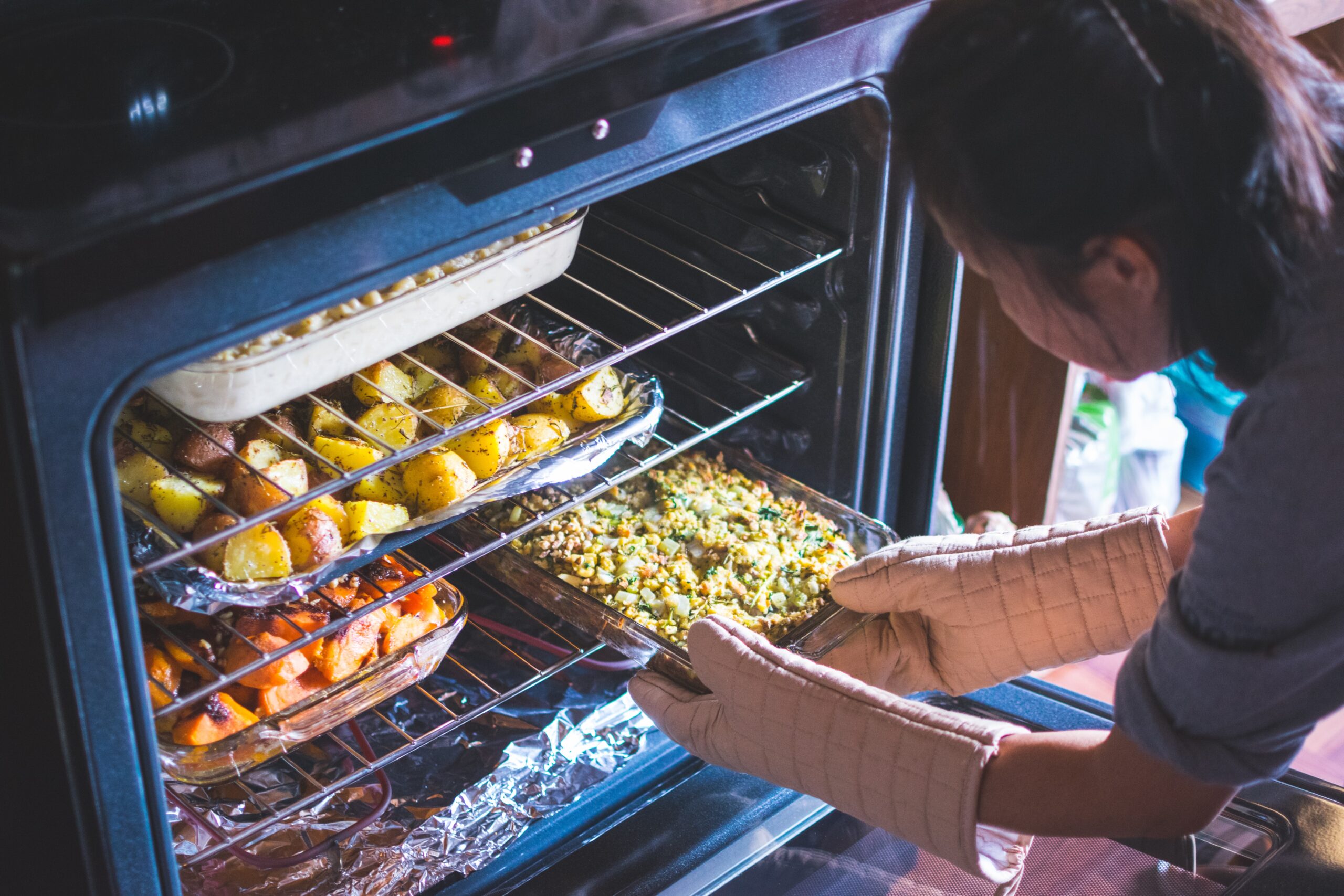
Don’t preheat your ovenThe ubiquitous recipe advice hails from an earlier age.When temperatures drop, home cooks break out the roasting pan. But recipes contain a lot of outdated lore, particularly admonishments to preheat your oven. Although pre-heating may be helpful for certain sensitive tasks like baking, your meat and vegetables probably aren’t going to notice the difference. How this helps When you preheat an oven, you’re spending a lot of energy to heat up a small amount of air — which then goes whooshing out when you open the door to put in the food. Preheating can be an especially pernicious habit if you turn on the oven before you start doing food prep, leaving it “running on empty” for half an hour or more. More information

Related tips
Comments
|


I think this is a good idea -- except most of the energy from preheating your oven goes to heating the inner walls of the oven itself, not the air inside. If all the heat whooshed out with the air, then your oven would be cool right after you take the food out!
Regardless, it's still a good idea for saving energy.
Reply
You can fine-tune this even a little bit more by considering whether you might be happy to have the spare heated air from cooking add to air you may be heating in your house as a whole, in which case you might want to let it fly a little more freely as you cook during winter, but shepherd it more carefully during warm weather.
Reply
The whoosh of hot air coming out of your oven, when you open the door to "peek" at your food, contains very little energy. Go ahead and peek, it's fun.
On the other hand, there is a lot of stored energy in the oven after you turn it off. We do preheat our oven, but then turn it off about 5 to 10 minutes before the timer goes off. The food is done, but not too hot to eat!
Yet another trick to reduce total energy used is a bit non-intuitive. Don't preheat, but do turn the oven up to a higher temperature for the first part of the cooking cycle. Then turn it back down to the "right" temperature and reduce total cooking time significantly.
Reply
For years I have used a "pizza stone" in my oven on the bottom shelf to help moderate and "hold" the heat. I have found that this thermal mass is incredible effective at transferring/radiating heat to the cooking objects regardless of whether they are directly on the stone or a shelf above it. It works very well in conjunction with turning the oven off early and even preheating another item on the burner that contains the oven vent (often the back left one).
Reply
In the summer I "bake" on the stove top. Good quality water tight stainless pans will allow you to "bake" just about anything on top of the stove. I do this with everythng from cake and quick breads to roast. French fries don't do well, but that's what the toaster oven is for :) - BTW a 2-3 min thaw in the microwave will shorten the bake time by half for french fries and chicken fingers.
Reply
Interesting notion and comments. However, my observation here is, and always has been, beyond the energy aspect and with the language usage aspect; I have never been able to "preheat" an oven. Every time I approach it I discover that it is "preheated". Then, when I turn it on it is "heating". Goes right by "pre"
Ain't that a kick in the head?
I've discovered the same thing with preplanning. Every time I start to preplan I discover that I'm planning.
And prepay and prelease and preregister, etc....(Just noticed here that I have an opportunity to "preview" my comments. Too late! I've already "viewed them.)
Reply
So one positive alternative is to put my old oven in a landfill and buy a new convection oven?
Reply
You don't need to put old appliances in the landfill. Most any scrap metal recycling business would be glad to take your old oven when you are ready to replace it. Some trash pick-up services will even pick-up your old appliances and take them to be recycled for you - for a small cost of course.
Reply
This might be true for less precise recipes (roasting vegetables, for example). but don't play with your oven temp if you're baking a souffle. You can also mess up things like breads and cookies by putting them in the oven at too low of a temperature. ever seen cookies spread out and melt together instead of rising? that might be why.
I'm all for reducing preheating times though -- you don't need to fire it up before you start prep. If you get a cheap oven thermometer, you'll know exactly when your oven is ready and won't waste time or energy -- yours or your oven's.
(ps. i'm a cook by profession.)
Reply
I have been doing that for years. The problem is hungry husbands and teenagers. They have a tendency to sniff and peek. I think I will print this article and post it on my oven for dinner this evening {;-)
Reply
The amount of energy used by your oven is utterly dwarfed by the energy used to grow, process, and ship the food to your kitchen. If by fiddling around with the temperature you screw up 1/20 recipes, you will actually increase your energy use.
Reply
Ellen - if you buy a new convection oven, the appliance store will most likely remove and dispose of your old one. Suggestion: get an oven that, at your option, can run as either a convection oven or a conventional oven.
Reply
Some additional tips that I employ to save energy is to use my toaster oven whenever possible. (The heat capacity in the walls and reduced air space of a small, light oven is much less than that of a big oven and helps reduce pre-heat times.) I take it out to my un-climate controlled garage during summer to reduce the AC load inside my house. Also, I find that the toaster oven handles about 80% of my baking needs, if I use its space judiciously. I also cook dinner later at night instead of during daylight to help reduce the peak demand on the power grid, and to help heat my house through then night during winter, or keep my AC costs down during summer. This trick I learned from my Spaniard, and Italian friends a few years back.
Reply
I think another outdated cooking practice is using 4 quarts of water to cook pasta. This seems to be at least twice as much as typically needed (depending on how much pasta is being cooked of course), and wastes time, water, and energy. I wonder how many other cooking practices go unquestioned and propagated by industry.
Reply
Not oven related, but I use the oven 1/10 as often as I use the range to boil water for tea/coffee.
If most people are like me, they boil water in a kettle every day, several times a day.
"Simplex" is a brand of copper kettle, with a flame catching bottom rim thing that boils in 1/2 the time of my old cheap kettle. 1/2 the gas, 1/2 the CO2, half the running cost.
Another one of those, "pay more up front and it'll eventually pay you back" purchases.
Ony good for gas cookers.
Has a whistle so you won't forget it. (I welded my last kettle to the ring)
Apologies if this sounded like an advert but you too can wear a smug grin every single time you drink tea.
Reply
In re: outmoded/wrongheaded cooking practices and pasta.
The perceived wisdom is that pasta should be rinsed after cooking but the fact is that that is an unecessary, water-wasteful practice.(except when you plan to use the pasta cold in a salad)
Reply
Don't forget the Solar Oven, Solar Oven, Solar Oven. Pete, when can I buy one in the store?
Reply
Convection ovens are a great invention, but to use one you have to adjust cooking temperatures and amount of time (lots of good info on the web).
I tend to do my cooking when my house could use the extra heat, and
put multiple items in; as long as I don't overload it (you need a good flow of air around the items, and preferably not in pans with high edges....)
and, re: cooking with too much water/wasting energy -
I cook corn on the cob in the microwave - leave some leaves on (or use wax paper) and cook for about 4 minutes/ear (+/_). Clams can be put right on the grill, instead of the huge pot of water (unless you really MUST have the clam juice). They cook quicker, and I think taste better.
Reply
I have found if something takes over a half an hour to bake in the oven, pre-heating is a useless thing(sorry mom)I just stick ehatever I am roasting or baking in the oven and maybe give it a 5 minutes longer. Another trick I do is use my toaster oven for frozen goodies
Reply
Nice to see Ariel chime in about souffles etc. I use the oven not so much since I gave up homebaked cookies, but I I've experimented a lot and I gotta preheat the pizza stone, all the way to 400. It gives awesome results (use parchment paper).
BUT I will turn the oven off sooner now that my awareness has been raised.
And I put the kettle the vent on the range top to hold some of the heat that would otherwise get exhausted out (kinda like the pitchers of water I keep in the fridge.)
Reply
Please, please NEVER put poultry or pork into a nonpreheated oven - would you leave it on your countertop for hours? Nope! Please experiment with your recipes - the nonpreheating technique is a good theory but it DOES NOT translate into edible food 100% of the time - you may be disappointed or ILL if you do this without some forethought.
Reply
On the note about corn on the cob, if you leave the husk on and put a little bit of water inside the husk it cooks on the grill just fine. I'd recommend trimming off any loose dangly parts of the husk though, no one likes a bbq fire =).
Reply
Janet, it's my understanding that once the inside of the meat reaches 165 F (or lower for some kinds of meat), it's done, all the germs are killed off - no matter how much they tried to grow beforehand.
Reply
Food Service Technology Center, a public research facility in CA, specializes in this type of thing. They research energy-efficiency in commercial food services and have some great tips and advice for restaurant operators and the average user alike. Check out some info at www.fishnick.com
Cheers.
Reply